Joe Alterio's blog on illustration, comix, design, animation, and other bouts of total awesomeness.

Showing posts with label concepts. Show all posts

Tuesday, October 07, 2008

Concept Art for Robots and Monsters Book


I've been hammering away at a pitch for a Robots and Monsters graphic novel, and I created this for another round. I won't let the cat out of the bag on plot details, but suffice to say, it has a lot of robots and monsters.

Saturday, May 24, 2008

The Biggest Drawing In The World


This guy sent a briefcase around the world via DHL with a GPS device inside: the GPS device recorded and sent back it's exact coordinates, which was plotted on a map of the world, creating the drawing above. Cool.

Saturday, May 17, 2008

That's the Whole Story

I was on the East Coast last week, to celebrate my Mom's 60th birthday in Boston, and see my dad in New York. Traveling always screws up my ferocious media consumption schedule: stuffed into my proverbial dog carrier, I'm forced to subsist on a lean mixture of cable news kibble and the occasional internet gruel. Being denied my usually over-the-top levels of wonkish political inspection is a forced starvation diet that's good for me, I think: during this interminable primary debacle fuckshow, I've actually spun out of the newscycle, exhausted, and then come back in...twice. It's the same reason I refuse to get a smart phone: I think if given the opportunity to be connected all the time, I just might drive myself insane. Like every good New Englander, I believe in a healthy dose of denial.

However, not having a completely and totally dissected political view was a boon to me in at least one regard: I was able to see the broad swath of the media narrative in much cleaner sense (er...not "cleaner" in the Joe Biden way.) As with any long, involved subject, being close to it sometimes allows the serrated edges to get in the way, and you lose track of the general direction. And the direction I saw was pretty obvious.

Let me state for the record, for whatever it's worth, that I'm a Barack Obama supporter: but I found it fascinating how the media turned off Clinton's chances like a light switch. For all intents and purposes, Hillary's chances pretty much tanked in early March: even after Pennsylvania, the math just wasn't there for her. The media allowed the horse race to play out because it was good news filler for the 24-hour stations and blog heads, and because, well, that's the way the nominating process works. But something weird happened after North Carolina and Indiana. They just sort of...shut off the switch. Even after Obama took a drubbing in W. Virginia, the NYTimes gave it a blurb below the fold at the bottom of the page: no picture, even.

This isn't a political blog, and I'm not to about blame vast media conspiracy for anything for than following the dog the richest smelling shit. But the fact that it took a bit of distance for me to see the full scope of a media arc was informative, and it began me thinking on a subject that dominates a lot of my mind: who is the taste maker, and where does the influence come from?

Narrative arc, be it for someone's career, political fortunes, or a cause, is a fickle and powerful tool, and is often times disturbingly close to innuendo, rumor, and hearsay. Going green is cool. Bill Clinton ruined his political fortunes. Lindsey Lohan is a drunk, Gary Busey is insane, George Clooney is a cool guy. The Iraq War was the right thing to do until about 2005, and now it was totally the wrong thing to do.
The conventional wisdom, and it's accompanying narrative arc, confuses and titillates me, because it seems such a ridiculous and arbitrary thing, that if harnessed, results in awesome power and riches; I 'spose it's kind of like the Cool Stock Market. The Tao Jones. Heh.

The tastemakers these days, much to the MSM's chargin, now lie firmly in the blogs and netroots, and for that, I'm glad: as someone who's tasted the brief power of a few BoingBoing links, I can attest to the new market's force. I'm not a political expert, and as I said, I didn't follow the web rumble up to the moment that the MSM turned out the light's on Hillary's campaign. But I wonder: what happens when the two don't work in concert?

This gets back to a more germane concept in regards this blog's theme, which is design and art and cartoons and everything in between, and wonder out loud whether there is a push or pull in design and identity, and how that works: does a preconceived notion of Obama as winner cause photographers to photograph him more heroically? Does the prevalence of zombie movies influence our scares about viral diseases, or do the disease scares cause the movies popularity? It's all a very tricky and interconnected labirynth of influence and confusion that I'm not about to pin down definitively. I don't pretend to have the answers. But it sure has been rattling around in brain a lot.

Thursday, May 08, 2008

Design Sausage Factory #3: Done Got Hitched


As you may know now if you're invited, we finished our Save The Date about a week ago. We're both really happy with it: as you can see from the above, I went back to the original look for the back side, and let the art on the front side speak for itself. The art is actually done by my mom. After weeks of scouring hundreds of images from the San Francisco library (kind of a crappy library for such a big city, if you ask me), wiki images, and bookstores, I finally appealed to my mom to create what I was looking for, and it's perfect. To suddenly be on the otherside of the equation - trying to art direct an illustrator about the vision in my head - was an enlightening experience. In any event, she did a great job, and these things look amazing. Thanks to my dad, too, for the printing. Sometimes it pays to have a graphic family, you know?


Looking at the other posts about this, I think the thing I take away again is that I sometimes have a tendency to get too tricky: too many cues, influences, and signifiers of the feeling I'm trying to impart. As a long time illustrator but less experienced designer, I just need to trust my audience more, and not let my illustrative instincts get in the way. The reason the first version didn't work, and this version does, is because the single theme is uncluttered by competing, subtly different messages. It really is true what they say: keep it simple, stupid.

Wednesday, February 20, 2008

Sketchblog


Kevin asked me to create a logo for his video company: Quoth Kevin:

"...something a little more baroque/russian futurist/steampunk - like a blueprint for a redesign of an alternate-future video camera with a lot of swoopy curves and stuff. Hell of a lot more work, I know."

It's cool, Kev. You're shooting my wedding.

Above is my first stab, and then out of boredom, I put it in an environment. I kinda like how it looks. And I want one.

Monday, May 07, 2007

The internet as a force of destruction

Drawn today has an interesting post today on Stephen Beisty, the illustrator most well known for his cross-section series: I picked up the Man-o-War one when I was a 16 during my I-wanna-be-a-pirate-phase (before it was cool!), and have been hooked ever since.

You'll notice that I didn't link to his site above: that's because he doesn't have a site. (Gasps from audience, woman in front row faints). He's not part of a collective, he doesn't put his work on an agents site, and the shock, the horror, he doesn't even have a BLOG. Jaleen from Drawn makes a trenchant point, in that Beisty's work isn't something that translates well to the web, and Beisty is hesitant to put enormous files that show the true scope of his work on a site, for fear that it may be stolen or manipulated, and that is all valid. But I think that the issue reaches deeper than that, and I think this is one of the better examples of the web defining the ground rules rather than the other way around.

To define the web as anything other than an enormous potential canvas is intransigent, but to define it as limitless and completely freeing is also being a willfully blind to it's very clear guidelines. The web, like any other media, has rules that ease of use demands you abide by. You can experiment all you want, but if you're writing a book, and you don't place the paragraphs of a story in order, you can make an interesting art project, but your readers will have a tough time getting what your book is about. And the web is the same way.

To not exist on the web is to really be at a deficit in terms of whether people can find you or not. That is clearly still be processed by a great deal of people in the creative fields, and the sea-change is even greater than people realize. The repercussions are being felt throughout the creative world, across a multitude of industries. In the old days - my mom's days - an illustrator would get an agent by getting the gumption to stop by offices of illustration eps, after which, if taken on, the rep would send out postcards and place ads in illustration annuals, to get the work in front of art directors. Now, the reps are broke due to stock illustration, the postcard printers are replaced by Kinko's, no one reads the annuals anymore, and if an art director really does want to hire an illustrator for custom work, where do they go to find that illustrator? The web, of course.

As a burgeoning self-promoting force to be reckoned with, it's not a lie to say the creation of a presence online is a lot of work. Besides the basics of actually creating a site, a creative person who doesn't have the money or is too much of a control-freak to pay someone else to do it needs to immediately become a novice web designer and info architecture acolyte to be a part of the party. Beisty is lucky to be successful and well-known enough to not need this presence online. But Joe Schmuck (or maybe Joe Alterio), that unknown artist who's trying to break in to the worldwide junta of getting paid for art? He's up a creek. Jaleen argues that if you don't exist online, you don't exist, and tragically, that's correct.

So to exist, an artist needs to learn how to build a site. They need to figure out how to get their work posted. They need to get their numbers up. Make sure they come up first on a Google search. That means getting linked to, so they should have a blog to let people know what they're up to. And they really should syndicate that blog to track their readership. Getting featured on BoingBoing or Drawn helps. Better be letting them know you exist. And all this, now taking time away from the actual creating of work.

Is there any grosser word in the world than "usability expert"? Ugh. Just typing it makes me shudder. The "usability expert" is the beginning of the end for creative types. Placing these laurel wreaths of Web 2.0 around our brow is creating a system that rewards the processing and delivery of content, while being completely devoid of any real deliverables. That Beisty is somehow now at a deficit because he spends his time on his gorgeous craft, and less time dicking around with Dreamweaver, is a total disgrace. To think that in 20 years time, we'll all be "usability experts", figuring out the best way to hand off all our great content as quickly and efficiently as possible, is a joke to me. The internet as a self-defining cage is already a reality: already, 95% of blogs are just recycling what someone else already posted. Where's the breaking point? When will the day come when the entire web is just different iterations of the same single idea, processed and homogenized through one million and one linked sites?

Friday, April 20, 2007

The Art of Manufacturing Nightmares

I don't usually do this, and leave it to my good friends at Suicide Bots to cover the coming Robot Revolution in our world, but this is too freaky/cool to ignore.


Meet Ava. She can talk physics with you, direct you to where you need to go, and her neck in fused to a piece of wood. Ava is created by Dave Hanson, and will be haunting my dreams for weeks to come.

Thursday, February 15, 2007

Form Is Content

I've been thinking a lot lately about semiotics, more specifically in my chosen field of practice, that is, the effort to tell a story with pictures. Without getting too Scott McCloud on you, I find some interesting cultural revelations that come out of the nearly nascent connections that make between form, inferred meaning, and underlying content. Much to the programmers delight, this is one instance where form really is function. Which is why I guess I like it so much.

Comics is a language of symbols, perhaps more so than any other visual art form. While traditional painting may have it's expressionist cues, kabuki may have it's grotesque masks, and while William Safire continues to mercilessly pound all the fun out of language every week, comics is like no other. At once overty symbolic and simplistic,


...and at the same time wonderfully, mysteriously open to interpretation, as intriguing as any subtle performance of the silver screen, comics has less to rely than other forms, and thus has more symbols at it's behest. Taking for granted the fact that I believe that comics actually solidified the "Z" as a shorthand for sleep in our culture ( Doozex, thanks Mort Walker), the joke here by Schulz is twofold: the 'surface' joke of Schroeder hammering Snoopy's sleep to bits, but also the underlying joke that you can get away with something like that comics it's the visual gag of seeing something obviously ridiculous used to portary an emotion that's tough to write. Another example:


It's funny because Linus is over the moon, and it's also funny because not only is Linus is floating, but that we actually KNOW what that means, and we can chuckle in an expert way. Symbology of this level makes us all insiders, and thus makes such art even more personal.

Comics is filled with such inside jokes: the lightbulbs, the speed lines, and clouds of smoke that inform our collective knowledge. As usual, McCloud has some brilliant points about the cultural disconnect when one culture doesn't understand another's symbology, and I won't rehash that.

I will say, however, that this is all the tip of the iceberg. I'm constantly surprised that comics, and for a time, silent films, are the only art form to consistently use such intimate semiotics to make a connection with the audience. Is it the lack of multiple panels ( "canvases") that make other artists less willing to use valuable real estate on something as prosaic as symbols? Shunning of common language for the desire to create something wholly unique? Or just that such symbology is often called "comic" symbology, and still viewed a bit huffily? There are a few artists that have delved into this realm, to great affect, I think. I can't wait for some more to come out of the woodwork.

Friday, January 05, 2007

Sketchblog 1/7/07

I just completed some storyboards for an agency here in town for a Visa campaign, and these are the ones I actually feel like showing to the public. The concept was showing small business owners day dreaming about the $250,000 prize offered in a new Visa contest. I don't really know what to say about these, except that I'm really proud of the way my bursh skills are coming along: I don't have it down completetly, but I'm getting there.
Monday, November 27, 2006

Sketchblog 11/26/06


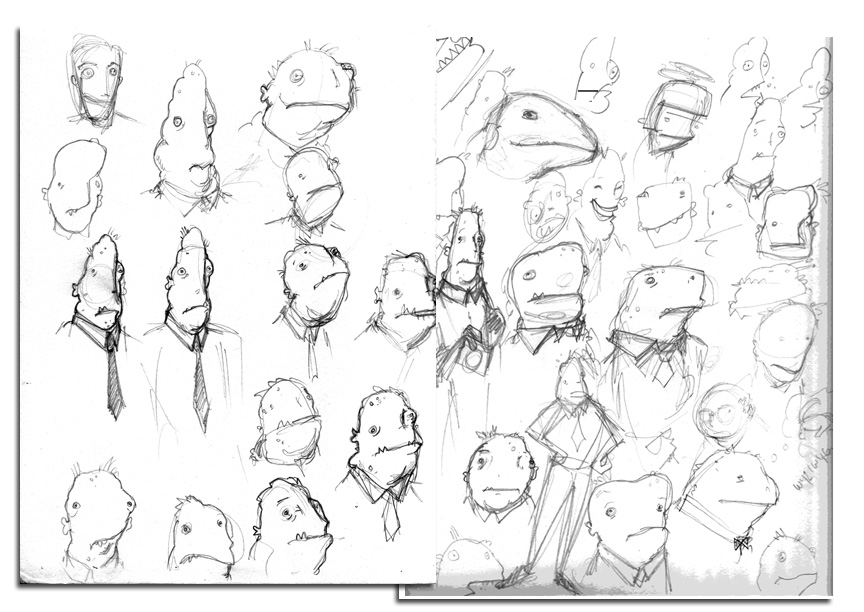
So I got an email from Aida in Iceland (!) who asked about my character development process, and how I decide what someone should looks like: she suggested that since I'm going to be drawing that character a great deal, I had better like them. I couldn't agree more.

For my part, I always have that great quote by Matt Groening running through my mind:

"The great, memorable characters in cartoons in the 20th century are characters you can identify in silhouette."

Above is my sketch when trying to come up with the look for Hector. Hector is...well, I don't want to give anything a way, but he's of a group of folks in the comic that have been physically altered in some way. As you can see, the guy I drew in the bottom right corner was the one I evenutally went with: because Hector is essentially a 'good guy' (albeit reluctantly), and a main character, I couldn't have him be too grotesque. But don't think that these other guys won't be showing up somewhere along the line. I especially like the guys in the upper right. My Troma love contiues to rear it's ugly head.