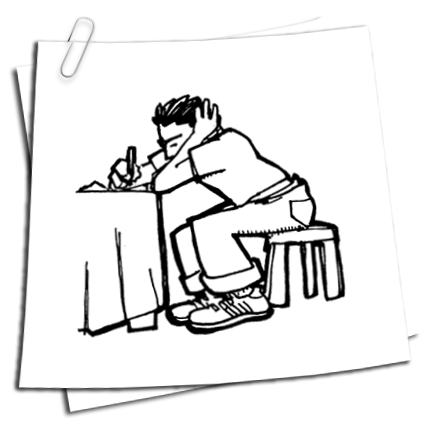
Comics is a language of symbols, perhaps more so than any other visual art form. While traditional painting may have it's expressionist cues, kabuki may have it's grotesque masks, and while William Safire continues to mercilessly pound all the fun out of language every week, comics is like no other. At once overty symbolic and simplistic,

...and at the same time wonderfully, mysteriously open to interpretation, as intriguing as any subtle performance of the silver screen, comics has less to rely than other forms, and thus has more symbols at it's behest. Taking for granted the fact that I believe that comics actually solidified the "Z" as a shorthand for sleep in our culture ( Doozex, thanks Mort Walker), the joke here by Schulz is twofold: the 'surface' joke of Schroeder hammering Snoopy's sleep to bits, but also the underlying joke that you can get away with something like that comics it's the visual gag of seeing something obviously ridiculous used to portary an emotion that's tough to write. Another example:

It's funny because Linus is over the moon, and it's also funny because not only is Linus is floating, but that we actually KNOW what that means, and we can chuckle in an expert way. Symbology of this level makes us all insiders, and thus makes such art even more personal.
Comics is filled with such inside jokes: the lightbulbs, the speed lines, and clouds of smoke that inform our collective knowledge. As usual, McCloud has some brilliant points about the cultural disconnect when one culture doesn't understand another's symbology, and I won't rehash that.
I will say, however, that this is all the tip of the iceberg. I'm constantly surprised that comics, and for a time, silent films, are the only art form to consistently use such intimate semiotics to make a connection with the audience. Is it the lack of multiple panels ( "canvases") that make other artists less willing to use valuable real estate on something as prosaic as symbols? Shunning of common language for the desire to create something wholly unique? Or just that such symbology is often called "comic" symbology, and still viewed a bit huffily? There are a few artists that have delved into this realm, to great affect, I think. I can't wait for some more to come out of the woodwork.